
You might notice that SlowLine only teaches a few animation classes, and that they aren’t the classes we’re starting with. They have prerequisites. Why is that?
It’s one of the first things I want to address, because it’s important to understand my philosophy about animation. Given a blank slate and the chance to teach artists from the ground up in my own way, I wouldn’t feel like a responsible instructor if I didn’t first give artists a starting point and a general understanding of what they’d be getting into. I teach classical animation (and if you want to know more about THAT, I have another post for that).
Teaching animation to people who barely know what it is would be like training someone to be a runner without knowing whether they should be a sprinter, a long-distance runner or… a football player! Or teaching someone to build a house before they know how to use tools, stay safe and read plans, only to find out they’d rather be a cabinetmaker.
In short, I believe artists should get to choose whether they really want to be animators, or whether a different, related role in the animation pipeline suits them better. Some people think animators do it all. They don’t, or at least it’s rare. (I could talk about how animators can become generalists and succeed in several roles, but we’ll leave that for later.)
“Animation,” the way many people think of it, is actually made up of several roles with very different skill sets. In this post I’ll cover concept art, storyboarding, character and prop design, background and location design, and finally animation, all for 2D and traditional animation. I’ll leave out roles like colourists, compositors and FX animators. I’m happy to talk about them, but I don’t teach them.
What is concept art?
Concept art isn’t animation. When the creators of a story want to turn it into animation, concept art is a good first phase for exploring the “look” they want. A Disney feature and SpongeBob SquarePants look nothing alike, and there are tons of incredibly talented artists whose unique styles have never been seen.
Concept artists listen to the creators’ early ideas and come back with sketches that might include unique designs, palettes, line or brushstroke styles and many other ideas to help the creators find a place to start. The concepts usually get narrowed down to a more final idea of the look, which then gets passed on to the character and background designers.
Why don’t I teach a concept art class? I may, if there’s demand for it!
What is storyboarding?
Storyboarding isn’t animation either. In 2D animation, a storyboard artist reads the script and script breakdown and works alongside the director, so the director’s vision of the story can unfold on screen the way they see it.
Maybe the story opens on an extreme wide shot of a sleepy little town, with the camera slowly trucking in toward a house with the kitchen light on. A mother is making breakfast for her kids, but since the story is really about a mouse, every angle in the kitchen is from the mouse’s point of view. Panel by panel, the storyboard artist sketches the story with a variety of camera angles, showing what the audience will see. They draw the wide shot of the town and note the camera move toward the window, and how long it lasts before a cut or cross-dissolve into the kitchen. They draw more panels from the mouse’s point of view: scratches on the floor, crumbs, the underside of the kitchen table. And they sketch the characters in the scene, showing when they enter and sit down, again from the mouse’s point of view.
A storyboard artist needs to see and understand the director’s vision, have some experience with perspective and drawing characters, take direction well and become a master storyteller. They keep the integrity of the story, follow direction and know when to suggest something that makes a moment even stronger. Storyboard artists are well-rounded. They draw fast, but they don’t always need to be technically accurate. Storyboarding is also one of the best roles for growing into story and directing.
What is character and prop design?
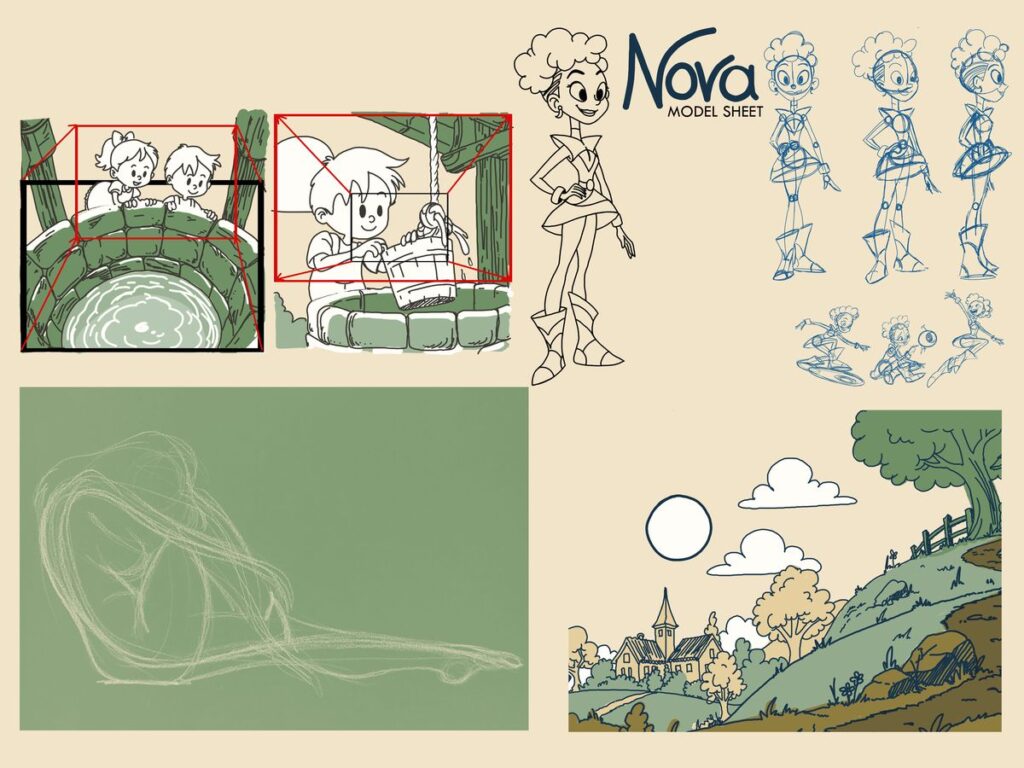
Designers aren’t animators either. Character designers are skilled technicians who create model sheets: blueprints that show animators exactly how to draw a character, and how not to. A model sheet breaks down how a character is built and which basic shapes sit underneath the details. Those simple shapes tell every animator the size and shape of each part, how the parts relate, where the details go and how the character moves. Not every character has the same abilities or flexibility. There are strict rules to follow.
On an existing show, character designers need to design in that show’s exact style. If an artist only ever draws anime characters, they’ll need to learn a range of styles to earn a place as a character designer. Showing you can design a new neighbour for Bart Simpson, a new pet for Rick and Morty or a cousin for SpongeBob matters if you want to be a character designer. If those skills land you work for a while, you’re well on your way to a seat at the table when a brand-new show needs something original: YOUR personal style of character design.
Props are no different. Prop designers need the same skills to create technical blueprints for props in the show’s style, often from several angles and sometimes showing how the prop is used. An artist who ONLY likes drawing props probably doesn’t need the same anatomy and basic animation training as a character designer, since they aren’t designing characters with human traits. They do need strong perspective skills, though, because most props are seen from many angles in an animated scene.
What is background and location design?
These artists aren’t animators either. They design the locations and backgrounds for animation, and the difference between the two matters.
Location designers take a big-picture view of where the story happens. If the story is set in a small suburban town, like The Simpsons, a location designer might draw a bird’s-eye view of the whole town, or of where the Simpsons live in relation to their neighbours. It could also be a plan of the Simpsons’ kitchen, showing where the fridge is in relation to the stove, how many upper and lower cabinets there are and where the doorway to the hall is. They map out the surroundings and help make these made-up worlds believable. Most of us know the Flanders family lives on one side of the Simpsons and the nuclear power plant isn’t across the street. Keeping things consistent makes everything more believable, and location designers do that for the environment.
Background designers have less say in who lives next to whom or how the furniture is arranged. They take their cues from the storyboard. When Bart and Lisa are talking at the kitchen table and Marge is at the sink washing dishes, the background designer draws backgrounds that match the location design and the storyboard angles. A close-up shows less of the background. A medium shot over Bart’s shoulder shows one side of the kitchen, and the same shot over Lisa’s shoulder shows the other side. And if Marge is washing dishes, the background designer needs to leave room for her too.
Location designers are usually experienced background designers who can do both. Background designers usually aren’t location designers yet.
Finally, what is traditional 2D animation?
Here’s where you find the animators! Woohoo! This is my personal favourite, which is why I can be pretty snobby about who should learn it and how it should be taught. My snobbery comes out a little later, and I make no apologies for it.
Animators aren’t storyboard artists or designers, but they rely heavily on both to do their work.
Animators study how things move, especially people and animals. They study movement and acting to an obsessive degree, and add just enough exaggeration of physics to make their characters believable. Think of Wile E. Coyote bending the laws of physics, the epic action in Demon Slayer, or the emotion of Dumbo being separated from his mother. Animators learn dramatic and comedic timing, posing and acting, and break it all down into 12 drawings per second.
Animators need to draw fairly fast and on model, testing motion and emotion, gravity and balance, while understanding the character as if they were acting the part themselves. Unlike designers, they don’t need to be as technically precise, and they don’t need to know every detail of the environment. It’s actually better if they don’t spend ages on one drawing or fall in love with their drawings.
It’s a lot to take in, and it isn’t for the faint of heart. It takes a special artist to be a great animator!
Then there are the assistant animators and clean-up artists. Key or lead animators are the senior animators, responsible for working out most of the action, timing and acting. They don’t draw all 12 drawings per second themselves. They draw the main parts of the action and pass the work and instructions to assistant animators, who fill in the rest.
When all the drawings are roughed out, clean-up artists take over and redraw everything, making sure every character is tightly on model with all the details. This stage calls for very technical artists with excellent attention to detail and superb line quality.
What is a generalist?
A generalist can be an animator, and can also do a variety of other roles. Because these disciplines are so different, generalists are usually not masters in any one area, but they show real strength across many. There are a few extraordinary artists who master everything, but that’s not at all the norm.
Analogy time. If you’re really into sports, chances are you’re not amazing at every sport. But if you like kicking a ball and you’re good at it, you’d probably make a great team player in several sports, even if you’re not the superstar.
Not everyone can be a generalist. You need basic skill in several areas. But if it is right for you, and you love using all your skills and dabbling across departments, you open yourself up to many more job opportunities. You’ll be competing against masters in each discipline, which can be tough. Then again, many studios see a strong, flexible generalist as a bigger asset than a master of one area. One thing is certain: as a strong generalist, you’re ready to be a one-artist show on a small project, for a client or for yourself.
What are the different kinds of 2D animation?
Time for my snobbery to kick in! As an industry veteran, I always start with traditional training and techniques. So much has changed since the early ’90s. The Simpsons moved from pencil, paper and cel animation to fully digital partway through its run, and new ways of animating arrived that changed the old-school techniques and hard work animators used to do.
Digital animation brought “symbol” animation, which let artists create shapes they could move with digital tools instead of drawing them over and over. That was fine, but if an artist wasn’t properly trained in animation, the result could look pretty stiff.
Before long, artists were being trained in software with more and more bells and whistles, so they could get motion and emotion without drawing every frame. It isn’t perfect in the eyes of an old-school animator, but stories still get told, with flatter characters in flatter environments, and acting carried by amazing voice actors. The stories are strong, and studios no longer need to pay for old-school artisans. Many animators have become animation technicians, and there is absolutely a place in the world for animation technicians.
I never made the jump to digital, so I’m not the teacher for emerging technicians. What I CAN teach are the old-school principles that still stand the test of time. With those skills, I guarantee that as a trained animator you can out-animate any technician who never learned them. You’ll also have the foundation to be a strong animator in any kind of animation, including 3D and stop motion.
So now you know. Animation is one thing. Animation drawing is a whole bunch of things, covering every artistic part of the animation pipeline.
So, what brought YOU to SlowLine?
Most likely, you love to draw.
- Do you already know exactly what you want to learn?
- Do you know what you love to draw?
- Do you know what you wish you could draw?
- Do you love to draw but have no idea where to start?
If you answered yes to any of these, you’re probably in the right place.
If you’re new to animation and not sure which part of the pipeline you’d love or excel at, I’ll always suggest starting with the Drawing for Animation Sampler. You’ll spend two weeks each on four core disciplines: figure drawing, character design, perspective and background drawing, and storyboarding. It’s the best way to find out where you fit, before you commit to one path.